
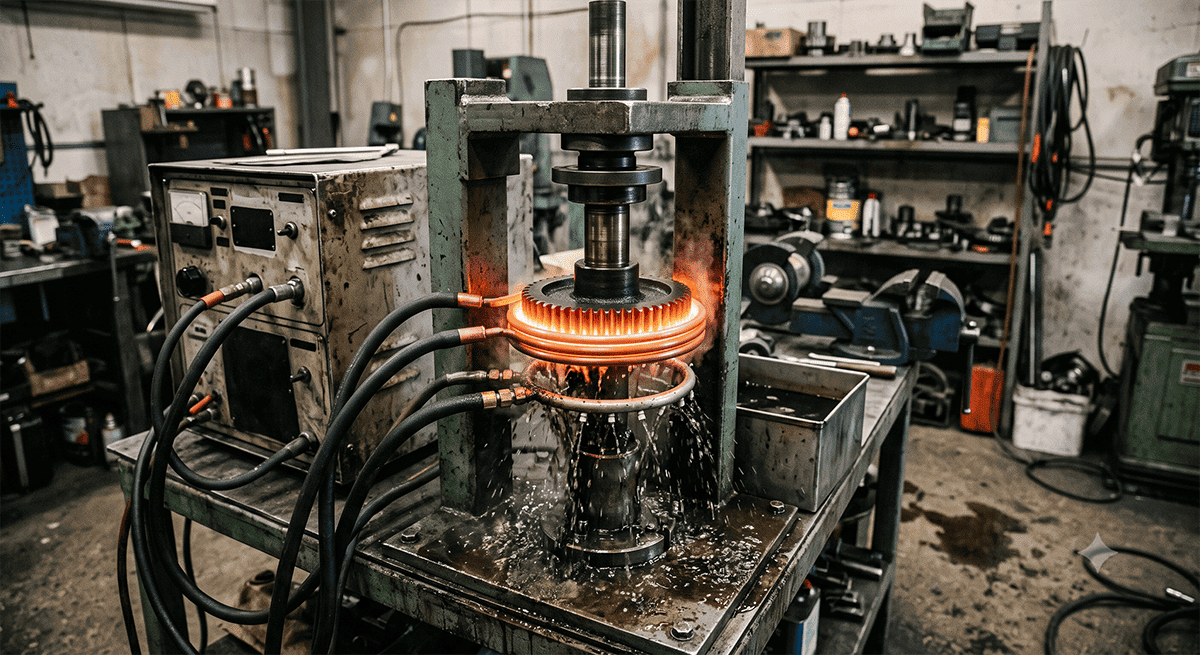
Induction hardening is one of the most advanced and widely used methods for surface hardening metal parts. In this method, instead of heating the entire component in a furnace, an electromagnetic field is used to create rapid localized heating at the surface. When the part is placed near a coil carrying alternating current, induced currents are generated in its surface layers. Because of the electrical resistance of the material, these currents produce heat and raise the surface to the austenitizing temperature in a very short time. A rapid quench then hardens this surface layer.
One of the most important advantages of induction hardening is its high precision in controlling both the hardened depth and the treated zone. Because heating is localized, the core of the part experiences less heat, and its internal toughness is therefore preserved. This characteristic is extremely valuable for components that need a hard, wear-resistant surface while also being subjected to dynamic and impact loading. In addition, short cycle time, high efficiency, automation capability, good repeatability, and lower distortion than some traditional methods are among the other major benefits of this process.
Induction hardening is widely used in the production of gears, shafts, crankshafts, camshafts, rails, pins, and many automotive and industrial machine components. This method is especially useful when localized hardness is needed in a specific area of the part. From an industrial standpoint, induction hardening is one of the most economical and effective methods for increasing surface resistance in modern production lines, and it plays an important role in improving the service life and performance of engineered components.