
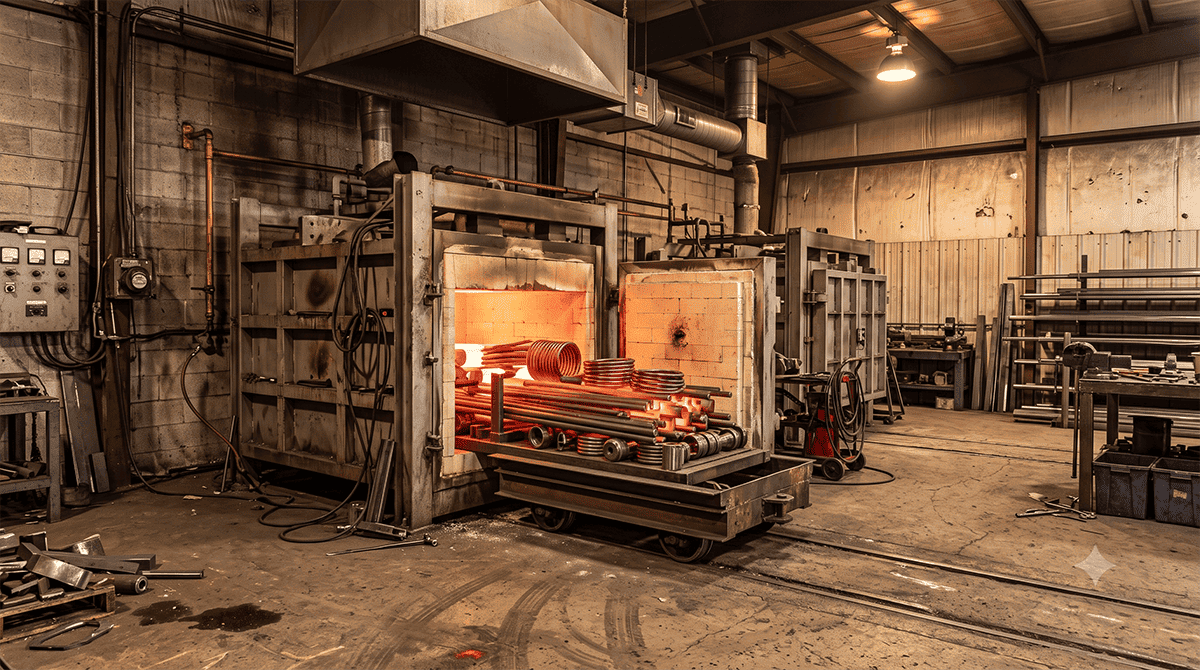
Annealing is one of the most fundamental and important heat treatment processes in materials engineering and metallurgy. Its main objectives are to reduce metal hardness, increase flexibility, improve machinability, and remove internal stresses generated during prior processes such as rolling, drawing, welding, forging, or machining. In this method, the metal part is heated to a specified temperature determined by its alloy type and structure, held at that temperature for a defined period, and then cooled slowly, usually inside the furnace. This controlled slow cooling is what helps reorganize the material's internal structure.
From a microstructural perspective, annealing reduces dislocation density, promotes recrystallization, and in many cases leads to controlled grain growth. In metals that have become strain-hardened during cold working, this process plays a major role in restoring lost properties. In steels, depending on the treatment temperature and carbon content, annealing can produce softer and more stable structures that are better suited for subsequent manufacturing stages. In practice, annealing is also a preparation process because it places the part in a more favorable condition for forming, cutting, or even subsequent heat treatment.
Industrially, annealing is widely used in the production of steel sheets, wires, tubes, cast components, and parts that have developed high internal stress after manufacturing. This operation not only improves the mechanical and metallurgical quality of the part, but also helps prevent cracking, warping, and problems caused by structural instability. For this reason, annealing can be regarded as one of the most essential methods for controlling metal properties and improving their reliability in engineering applications.