
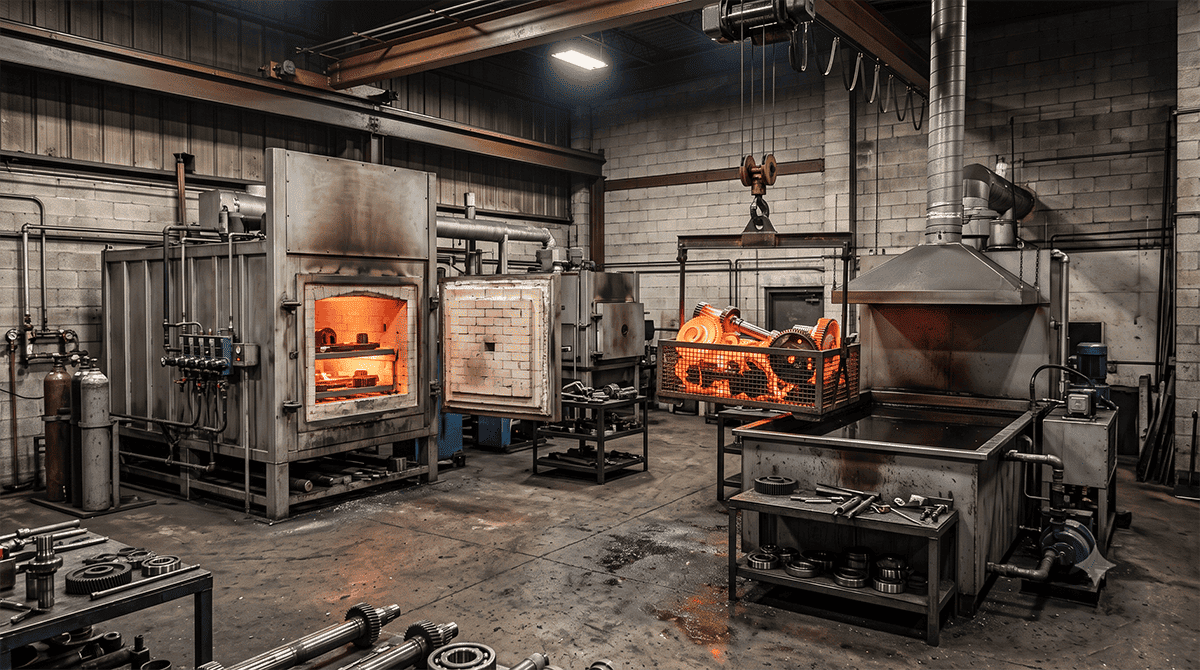
Carbon enrichment is a general concept in thermochemical heat treatment that refers to any process in which the surface of a metal, especially steel, is enriched with carbon. The purpose is to increase surface hardenability and create a layer that is more resistant to wear, mechanical contact, and abrasion. In many low-carbon steels, high surface hardness cannot be achieved on its own; therefore, enriching the surface with carbon provides the conditions for more effective hardening.
Increasing the carbon content in the surface layer allows the part, after suitable heat treatment, to develop much harder structures at the surface. This is highly important in applications where the surface is exposed to friction, wear, or contact loading. Carbon enrichment can be carried out by different methods, and the appropriate approach is selected based on industrial requirements, part type, desired depth, and economic conditions. In practice, carburizing is one of the most important and best-known forms of carbon enrichment.
In machinery manufacturing, power transmission, component production, and industrial equipment fabrication, carbon enrichment is an important tool for increasing service life and performance. This process allows engineers to benefit from high surface hardness without relying on very high-carbon and brittle steels. For that reason, carbon enrichment can be considered one of the key principles in surface engineering and performance improvement for metal components.