
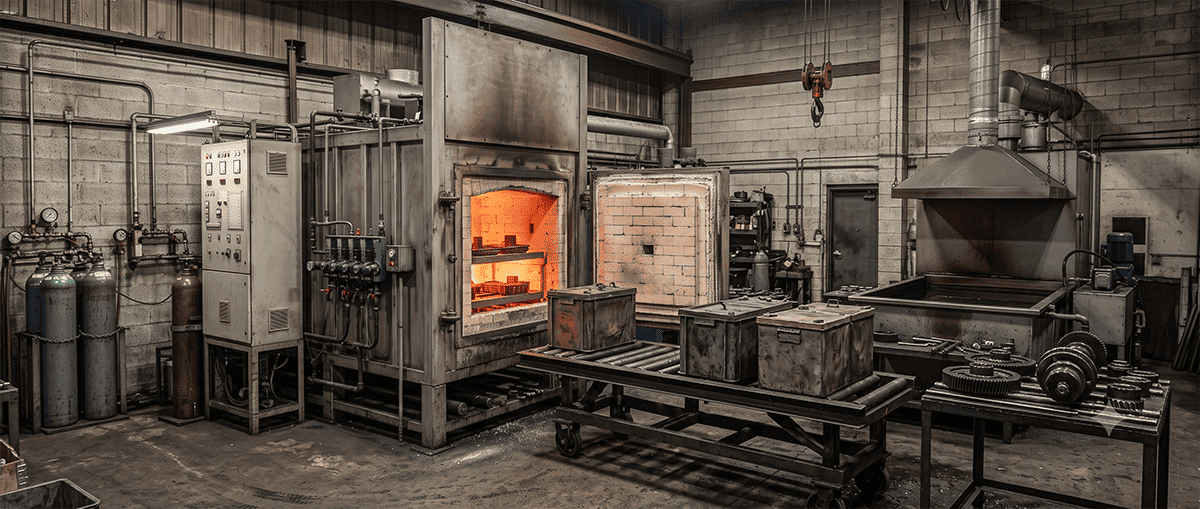
Carburizing is one of the best-known thermochemical treatments used to increase the surface hardness of low-carbon steels. In this process, the part is placed in a carbon-rich environment at elevated temperature so that carbon atoms can diffuse into the metal surface. After the desired case depth is reached, the component is usually quenched so that the carbon-enriched surface transforms into a hard structure such as martensite. The result is a highly wear-resistant surface combined with a relatively soft and tough core.
The main advantage of carburizing is that it provides two important properties in a single part at the same time: high surface hardness and impact resistance in the interior. This combination is extremely valuable in many mechanical components exposed to surface contact, cyclic loading, and friction. The depth of the carburized layer depends on factors such as temperature, time, steel composition, and the type of carbon-bearing medium. Careful control of these parameters is essential to prevent undesirable layers or part distortion.
Carburizing is widely used in the manufacture of gears, axles, shafts, cams, pins, bushings, and many power transmission parts. In the automotive industry, machinery manufacturing, and heavy mechanical equipment, this treatment is one of the primary methods for extending component service life. From an engineering standpoint, carburizing is a highly effective way to improve surface performance without sacrificing the internal strength of the part.