
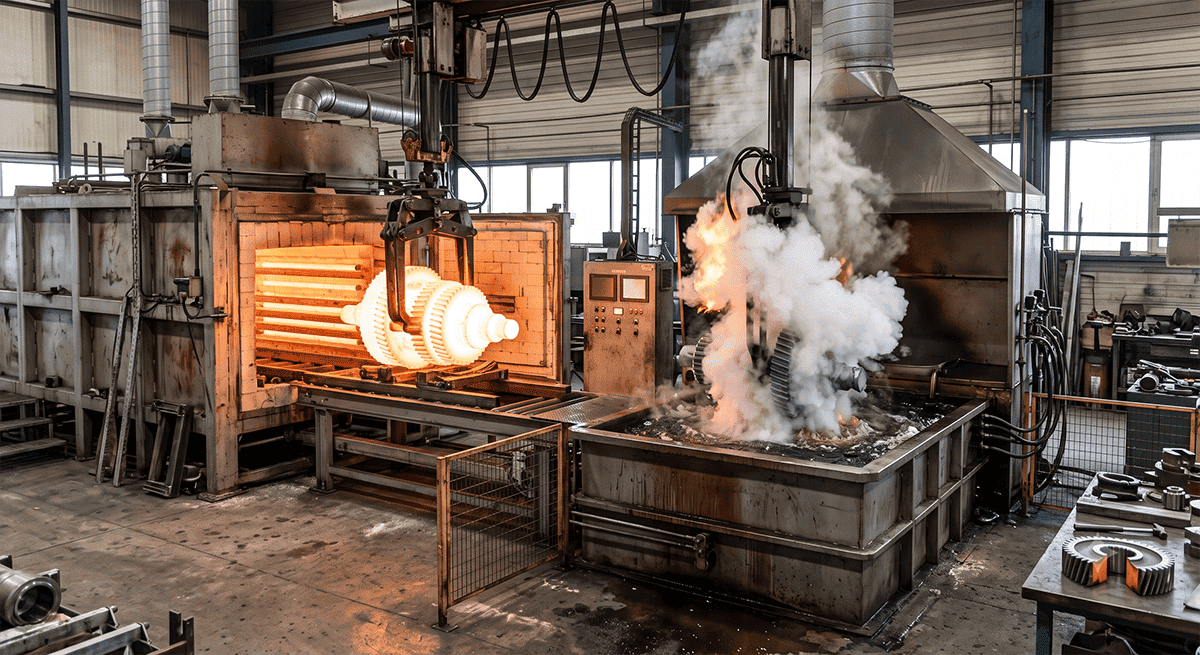
Hardening is one of the most important heat treatment processes in industry, carried out to increase the hardness, wear resistance, and strength of metal components, especially steels. In this process, the part is heated to a specified temperature so that its structure enters the austenitic range and is then cooled rapidly. This fast cooling prevents the formation of equilibrium structures and creates a very hard phase known as martensite. The presence of martensite is the main reason for the significant hardness increase achieved in hardened steels.
Despite its major benefits, hardening can create problems such as cracking, distortion, severe residual stresses, and even premature failure if it is not carefully controlled. Parameters such as austenitizing temperature, holding time, steel chemistry, part geometry, and quenching medium all play a decisive role in the final result. Steels with sufficient carbon content usually respond better to hardening because martensite forms more effectively in them.
In terms of application, hardening is used for parts exposed to mechanical contact, wear, heavy loading, or continuous friction. Cutting tools, dies, industrial shafts, bearings, gears, and machinery parts are among the components that benefit from this process. However, high hardness alone is not enough, and after hardening the part is usually tempered to prevent excessive brittleness. As a result, hardening should be regarded as a highly effective but sensitive process that plays a fundamental role in producing durable, wear-resistant components.