
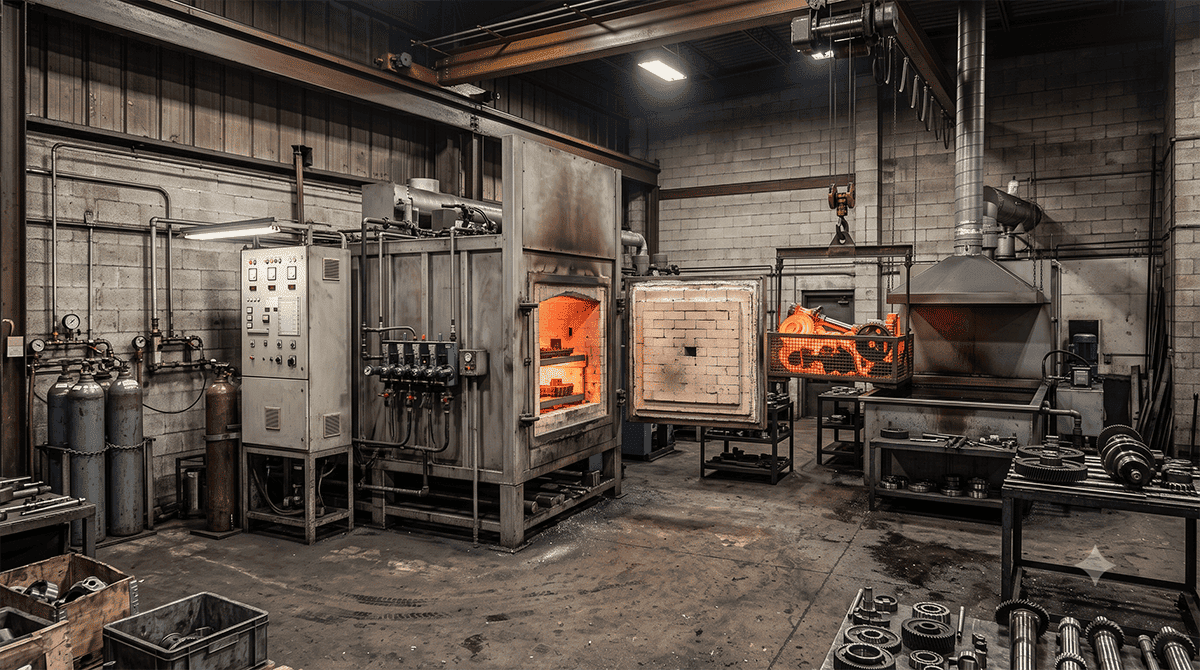
Homogenization is an important heat treatment operation mainly used for cast materials, ingots, and certain engineering alloys. During solidification, especially in cast components, alloying elements are not always distributed uniformly throughout the structure, and chemical segregation can develop at different scales. This non-uniformity can cause local differences in mechanical properties, difficulties in subsequent processing, and reduced final product quality. Homogenization is performed to eliminate or reduce exactly this problem.
In this process, the part or ingot is held at high temperature for a relatively long period so that atoms have sufficient time to diffuse and become more evenly distributed throughout the structure. As a result, concentration differences between regions are reduced and the material becomes more uniform. Homogenization can also reduce certain brittle compounds or unwanted phases and make the material more suitable for later operations such as rolling, extrusion, forging, or machining.
This treatment is used in the production of aluminum, alloy steels, superalloys, copper alloys, and many advanced engineering materials. Especially in parts that will undergo severe forming, homogenization can help prevent cracking, local failure, or unbalanced material behavior. For this reason, homogenization should be considered one of the fundamental and critical stages in preparing materials for precise industrial processes.