
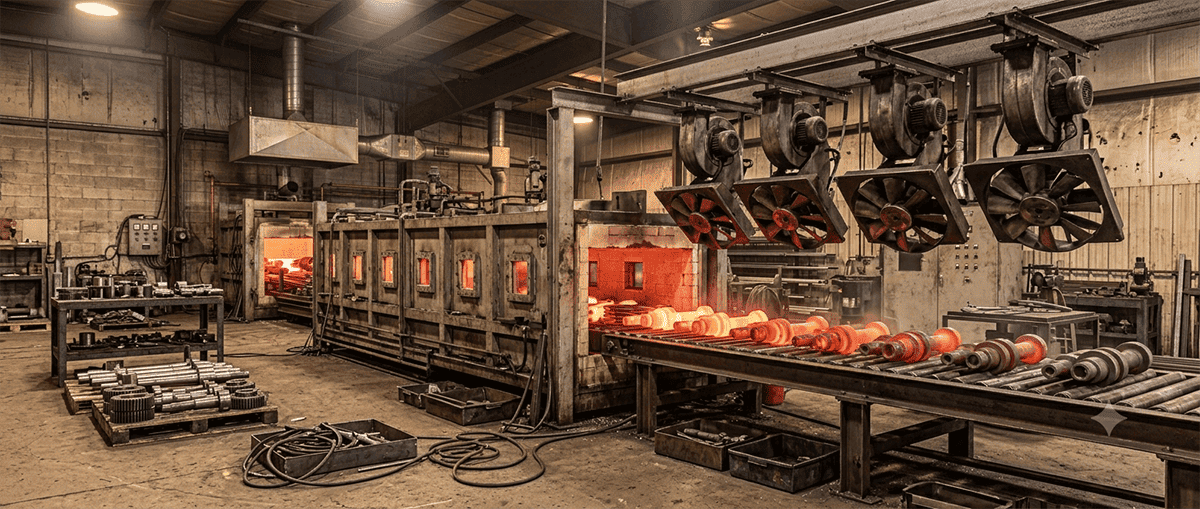
Normalizing is a widely used heat treatment process primarily applied to steels and some ferrous alloys. In this process, the part is heated to a temperature above the critical range so that its structure transforms into austenite, and it is then cooled in still air. The main difference between normalizing and annealing lies in the cooling rate: in normalizing, the part cools faster than in annealing, which results in a finer and more uniform structure.
Normalizing is typically used when a part has developed an irregular structure, coarse grains, or a non-uniform phase distribution after casting, forging, hot rolling, or welding. This process can refine the grains, improve mechanical properties, and prepare the part microstructurally for subsequent operations. In many steels, the final structure produced by normalizing consists of finer pearlite and more uniform ferrite, giving it greater strength and hardness than an annealed structure.
From an application standpoint, normalizing is an excellent choice when an engineer needs a balance between strength, toughness, hardness, and machinability. It is commonly used in the production of shafts, rough gears, structural steel parts, cast components, and forged parts. In some cases, normalizing is also performed as a preliminary treatment before hardening or precision machining so that the part achieves more stable and uniform properties. Overall, normalizing plays an important role in improving the metallurgical quality and mechanical performance of steel components.