
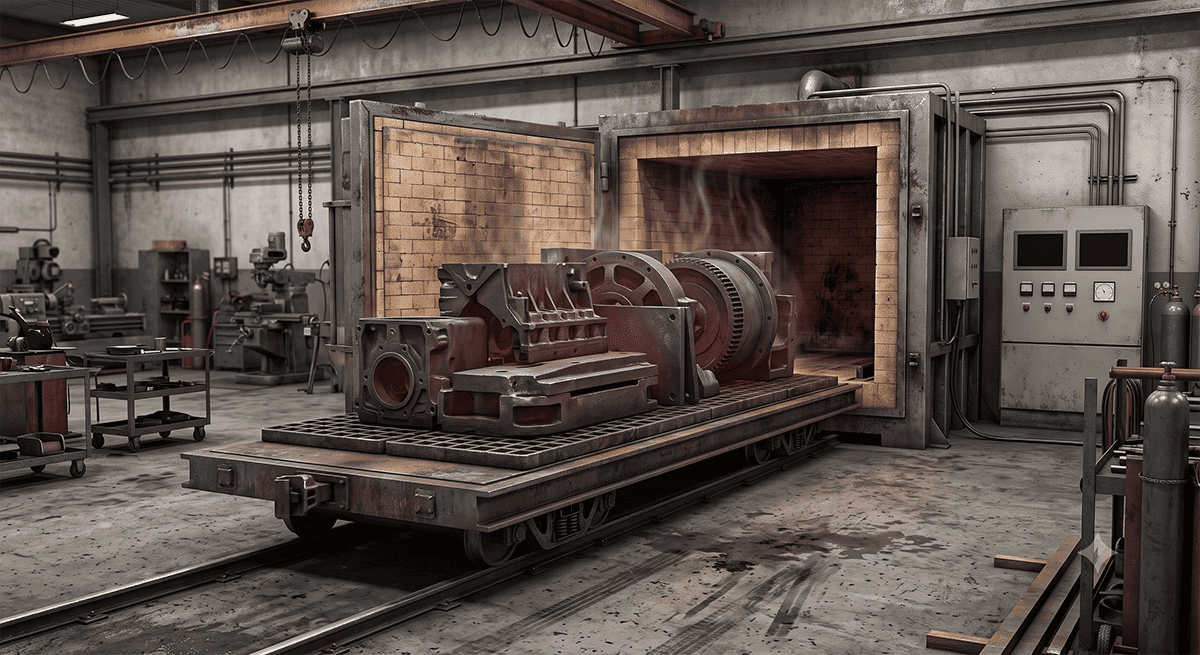
Stress relieving is a type of heat treatment performed to reduce or remove internal stresses present in metal parts. These stresses may arise from processes such as welding, casting, machining, rolling, forging, or localized deformation. Residual stresses in a component can lead to distortion, loss of dimensional accuracy, progressive cracking, and declining mechanical performance over time even without external loading. For this reason, stress relieving is especially important for many industrial and engineering components.
In this process, the part is heated to a temperature below the main phase transformation point and held there for a certain period. It is then cooled in a controlled manner. Because stress relieving usually does not involve a major phase transformation, its purpose is mainly to relax the structure and redistribute stresses rather than to make a fundamental change in the microstructure. This characteristic makes stress relieving highly suitable for parts whose hardness or structure should not change significantly.
In heavy industry, pressure vessel fabrication, transmission lines, welded structures, precision tools, aerospace parts, and power plant equipment, stress relieving is considered an essential step. This treatment can extend service life, preserve dimensional accuracy, and reduce the risk of sudden failure. Overall, stress relieving is a preventive yet highly effective process that ensures the long-term functional stability of metal components.