
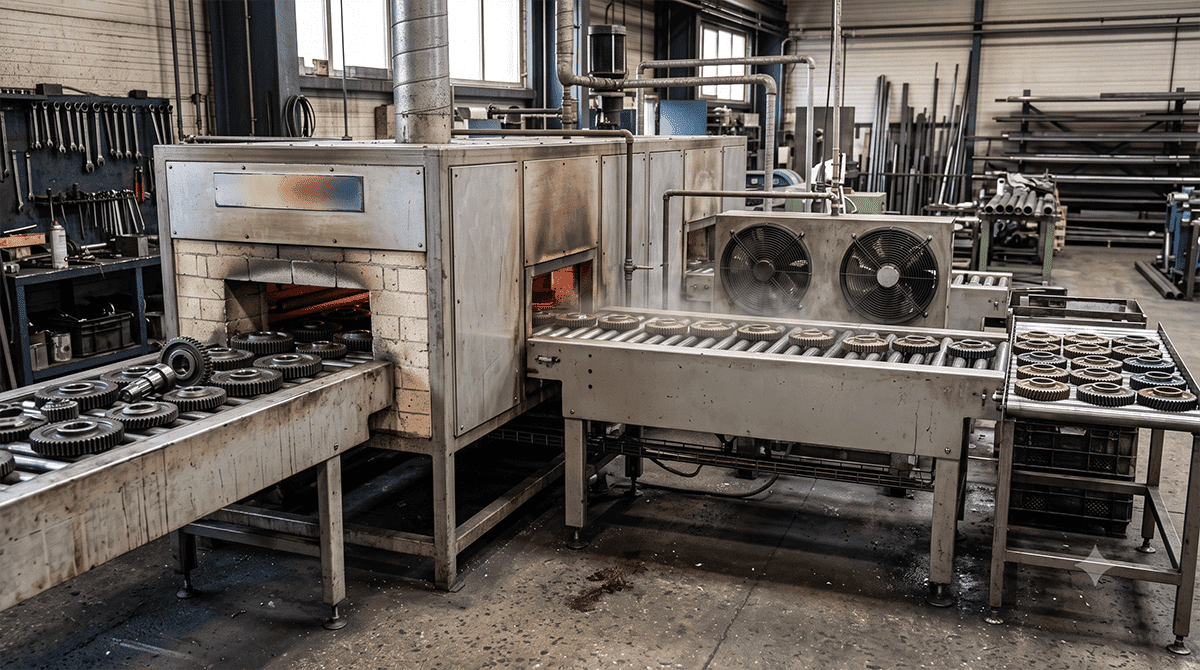
Tempering is one of the most important supplementary heat treatment operations and is usually performed after hardening. When steel transforms into a martensitic structure after quenching, it attains very high hardness; however, this benefit is accompanied by high brittleness and significant internal stress. Tempering is carried out to correct exactly these conditions. In this process, the hardened part is reheated to a temperature below the critical point, held there for a specific period, and then cooled.
During tempering, part of the residual stress is relieved and unstable martensite transforms into more balanced structures. As a result, the part loses some hardness, but gains toughness, impact resistance, and functional stability. Selecting the tempering temperature is extremely important, because lower temperatures usually retain more hardness, while higher temperatures produce a greater increase in toughness. In other words, tempering is a key tool for precisely tuning the final properties of a part according to service requirements.
This process is widely used in industrial tools, springs, automotive components, structural members, and many parts that require both hardness and suitable mechanical resistance. In practice, without tempering many hardened parts would not be suitable for industrial use because the risk of brittle fracture would be too high. Tempering can therefore be seen as the process that turns the hardness obtained from hardening into a practical and reliable engineering property.